


Marand’s saffron-growing area was reported to have increased by 15%, according to figures attributed to the city’s agricultural authority. The original report is a historical snapshot: its 90-hectare total, production estimate and monetary value describe conditions at the time, not the scale or price of saffron in Marand today.
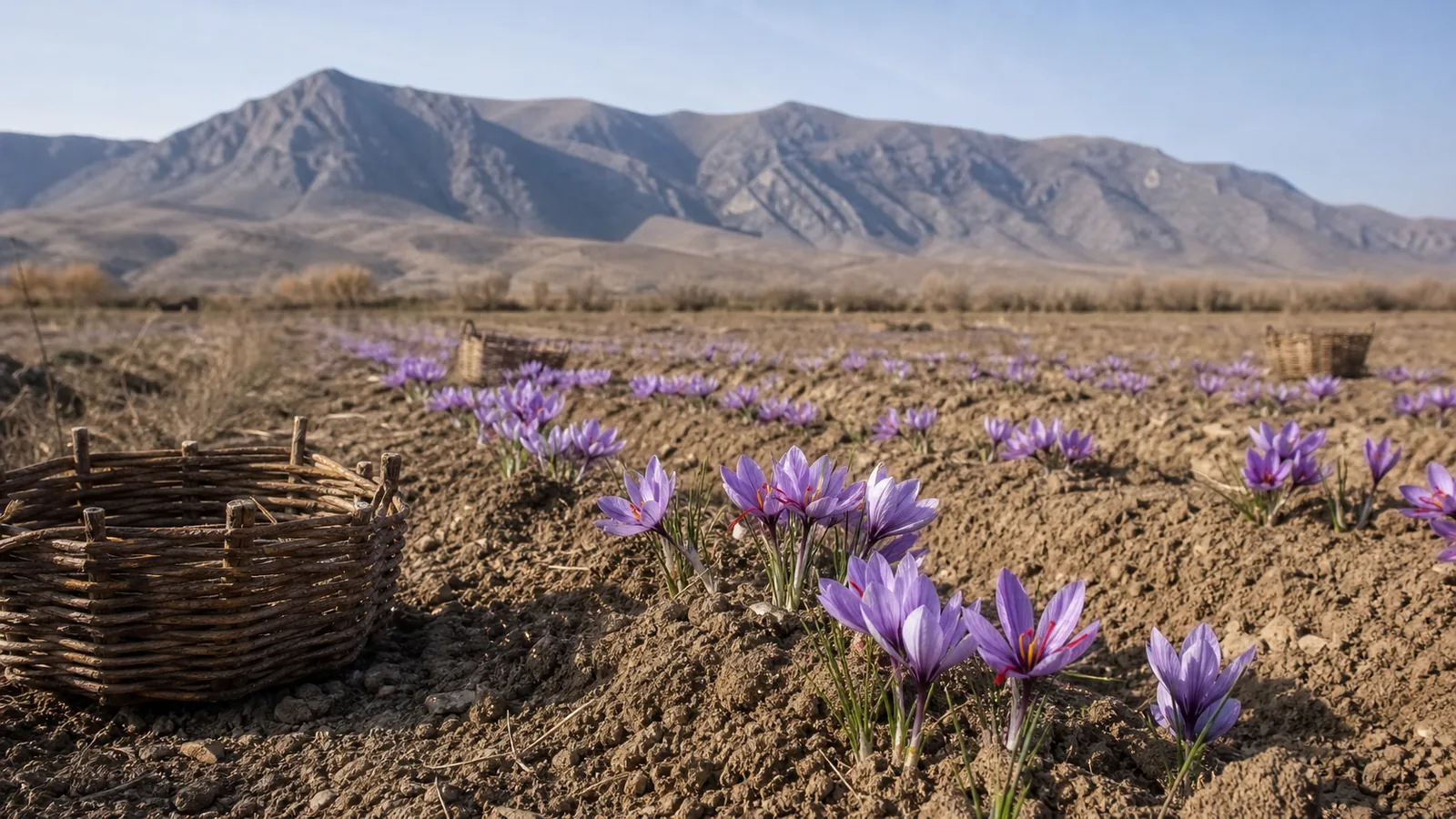
The reported 15% growth in Marand saffron land
Jalal Rahimzadeh, then director of Marand’s Agricultural Jihad office, presented the figures during the city’s second saffron festival. He said that around 250 farmers were involved in local saffron production and that the area planted with the crop had grown by 15%.
The report put the cultivated area at 90 hectares and forecast 360 kg of dried saffron. Those numbers imply an average yield of 4 kg per hectare. They belong together and have therefore been retained rather than separated or silently updated.
What the historical figures meant for growers
Rahimzadeh valued that season’s expected crop at 14 billion rials. This was a period-specific estimate, not a current market valuation. Saffron prices, labour costs and the value of the rial have changed substantially, so the number should not be used to calculate present-day farm income.
His main concern was the value lost after harvest. Without strong producer organisations or enough local processing and packaging capacity, much of Marand’s crop was sold in bulk within the province. Farmers did the demanding work of cultivation and flower picking, while a larger share of the later value could be captured elsewhere.
Processing and packaging were part of the plan
The local agriculture office announced a development plan for saffron processing and packaging. It called for investment in modern machinery and support for smaller producer-led units that could prepare and present the crop locally.
Packaging alone does not create quality, but careful drying, clean handling, suitable storage and traceable lots can protect a good harvest. They also make it easier to sell saffron as a recognised regional product rather than as anonymous bulk material.
Why Marand was considered suitable for saffron
Marand lies in East Azerbaijan Province, on the slopes around Mount Mishu, and contains several local climates. The report linked those conditions with the quality of the city’s garden and field crops, including saffron.
It also described a long expansion from roughly 1 hectare in the early 1370s of the Iranian calendar to more than 90 hectares by 1390. The original English text named 1371 as the starting year; a newer official account names 1372. That one-year discrepancy is retained here as a source difference rather than presented as a settled fact.
Marand saffron cultivation has since expanded further
Later figures show that the 90-hectare snapshot is no longer current. In an official agricultural report dated 14 Aban 1404, Marand’s cultivated area was put at 263 hectares: 247 productive hectares and 16 hectares not yet bearing. The forecast was 1,900 kg of dried saffron.
That update also credits farmer interest and changes in cropping patterns for the expansion. It describes saffron’s autumn and winter growth cycle as useful in a dry region because the crop does not require summer irrigation. Readers who need the current official figures can consult the Iranian Agricultural News Agency report on Marand’s 2025 harvest.
Aroma and colour are not complete purity tests
The earlier article suggested that a strong aroma by itself proves freshness and that a weak aroma means saffron is old or impure. That is too definite. Aroma can change with age and storage, but it can also vary with drying, packaging, temperature and the particular sample.
Good saffron threads usually show a deep red colour and a recognisable aroma, yet appearance and smell cannot establish purity on their own. ISO 3632 sets specifications and laboratory test methods for dried saffron, including filaments and powder. For commercial buying, documented origin, lot traceability and appropriate testing are stronger evidence than a sensory check alone.
The lasting issue behind the 15% figure
The original announcement was about more than land area. It recorded the shift of saffron into Marand’s farm economy and the need to keep more post-harvest value near the growers. The newer acreage and production figures suggest that cultivation did continue to expand. Processing, testing, traceability and credible regional marketing remain the practical steps that turn that growth into a stronger local saffron sector.

![Exporting Saffron to Turkey + Price Guide [Complete 0 to 100]](https://img.rowhanisaffron.com/20260827003933/saffron-export-turkey-quality-inspection.webp)



