


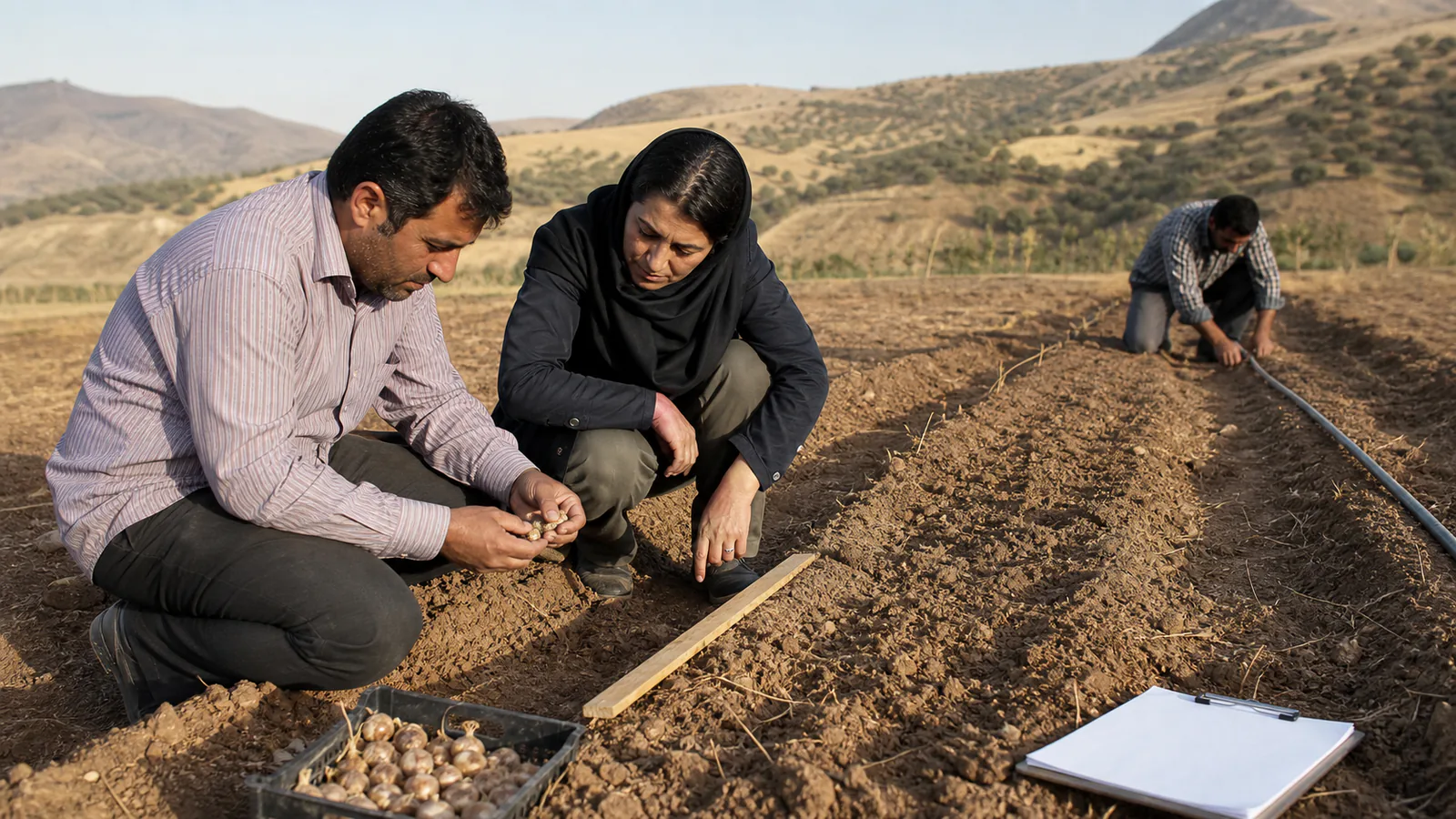
The reported 3-fold increase in the cultivation of saffron in Kermanshah came from a small 2015 expansion programme, not a claim that Kermanshah had suddenly become a major national producer. Shahriar Ghasemi, then identified as the county’s Agriculture-Jahad director, said eight hectares had been added and the total saffron area had reached 23 hectares.
Those two numbers do not show a threefold rise in total area. If 23 hectares included eight new hectares, the earlier total was 15 hectares and the increase was about 53.3 percent. The headline may have compared that year’s new planting with a smaller addition in the preceding year, but the missing denominator means the threefold statement cannot be reconstructed.
What expanded in Kermanshah in 2015
Ghasemi attributed the new planting to provincial Agriculture-Jahad support, farmer outreach and training from horticultural specialists and local service centres. He said farmers had responded strongly because Kermanshah’s climate appeared suitable and saffron was being promoted as a crop for continued drought and limited irrigation.
The article describes Kermanshah as a recent entrant among Iran’s saffron-growing provinces. Its 23-hectare figure is a county baseline for that crop year, not a current provincial total. Later Kermanshah statistics belong to different dates, geographic scopes and stages of field maturity.
Our broader account of saffron production in Kermanshah follows those later checkpoints. Keeping the dates separate matters because a newly planted hectare does not contribute the same yield as an established field.
The threefold headline is missing its denominator
A growth statement needs a starting value and a measure. “Threefold” could refer to total planted area, hectares added during the year, the number of participating farms or another programme indicator. Only two area figures survive in this report:
- eight hectares added during the current crop year;
- 23 hectares under saffron after the addition.
On that basis, total area rose from 15 to 23 hectares. The eight-hectare addition is 53.3 percent of the implied earlier total. It is also 34.8 percent of the new total. Neither calculation produces threefold growth.
That does not make the expansion fictional. It means the headline and the total-area series probably used different comparisons. A reliable programme record would publish the previous and current figures for the same boundary, crop year and definition of productive area.
Where the 23 hectares were located
Ghasemi named ten Agriculture-Jahad service areas as having the largest shares: Sarab Niloofar, Sar Firuzabad, Mahidasht, Chaqa Narges, Kuzaran, Elahiarkhani, Dorud Faraman, Bilavar, Mian Darband and Jalalvand. English spellings vary, but the list is worth preserving because it shows that the programme was dispersed rather than one 23-hectare block.
The report did not give hectares by location. Without that split, it is impossible to compare soil, elevation, rainfall, irrigation source or field age among the sites. Those differences would matter more to future decisions than the county total alone.
Corm source, planting date and field age
The planting material was described as saffron corms sourced from Razavi Khorasan. The damaged English version called them both onions and cassava. Crocus sativus is propagated with corms; the report offered no cultivar, corm-size, health, storage or certification record.
Ghasemi placed planting in late Shahrivar and Mehr and harvest in Aban. Those Persian calendar months fall roughly across September–October and October–November, but actual flowering responds to local temperature, soil moisture, planting date, corm condition and field management. The old calendar should not be copied as a universal current instruction.
He said flowering begins the year after planting and that a field can bear for seven to ten years. Longevity is not a fixed property of every plot. A six-year field study of corm size and planting density found that flowering and yield changed with season, corm size and environment: production rose through early years and later declined under the conditions tested.
That is why a new programme needs to record establishment year. Combining young and mature hectares can make county yield rise or fall even when management has not changed.
What the 4.5-kilogram yield meant
Ghasemi referred to a yield of about 4.5 kilograms of dried saffron per hectare. The report does not say whether this was measured on established local plots, expected from the programme or borrowed from another production region.
Yield depends on more than climate. Corm mass and health, planting density and depth, soil condition, irrigation timing, nutrients, weeds, field age, flower picking and stigma drying all affect the final number. A peer-reviewed study of dense planting and technical efficiency also warns that high corm density can bring earlier output while creating cost and land-sustainability trade-offs.
A single 4.5-kilogram assumption is useful for a provisional budget. It is not evidence that every hectare in the ten named areas achieved that yield.
The historical cost and revenue claims
The original Persian amounts were tomans, not dollars. Ghasemi put first-year corm supply, planting and crop care at 15–20 million tomans per hectare. He then described annual fertilizer and irrigation spending of about 2 million tomans and annual revenue of 28 million tomans from roughly 4.5 kilograms per hectare during the stated productive life.
These are 2015 planning figures. They are not current costs or returns, and the article does not provide invoices, saffron grade or sale price. More importantly, revenue is not profit. Subtracting only fertilizer and irrigation would omit land, corm replacement, soil preparation, planting labour, weeding, flower picking, stigma separation, drying, testing, packaging, transport, losses and finance.
The 28-million-toman result also assumes the crop reaches the quoted yield and the seller receives the implied price. New fields commonly have a different yield path from mature ones. A responsible budget would show low, expected and high yield cases rather than one promised return.
What support Agriculture-Jahad reported
Ghasemi listed three kinds of assistance. Five tonnes of saffron corms had reportedly been obtained and supplied free to planting applicants. The provincial organization also paid a non-repayable 40 million rials per hectare—historically equivalent to 4 million tomans—for corm purchase and part of establishment costs.
A separate facility offered 100 million rials per hectare, or 10 million historical tomans, at four percent interest through the Mehr Imam Reza Fund in coordination with provincial Agriculture-Jahad. The article does not state repayment length, eligibility, collateral, number of recipients, approval rate or whether every announced amount was disbursed.
Those details matter. A grant reduces establishment cost; a loan changes when the grower pays it. Neither proves that the field became productive or profitable. Our account of how Kermanshah supported saffron farmers covers a separate 2015 package and should not be combined with these figures.
Low water demand still requires a local water plan
The 2015 announcement used drought and low water demand to justify expansion. Saffron’s seasonal cycle can make it attractive where water is scarce, but “low water” is comparative, not zero. Establishment, autumn growth, flowering and daughter-corm development still depend on timely moisture.
FAO’s description of the qanat-based saffron system in Gonabad shows how a high-value crop and carefully managed water can support dryland livelihoods. Gonabad is not Kermanshah. Its qanats, climate, field history and local knowledge cannot validate a Kermanshah site without soil and water evidence.
Before expanding another hectare, a field assessment should check drainage, salinity, water timing and reliability, winter conditions, summer heat, previous crop and disease risk. The alternative use of the same land and water belongs in the comparison too.
How the expansion should have been evaluated
The 23-hectare programme needed a multi-year record, because the announcement mixed establishment with expected mature-field performance. For each plot, the useful measures would include:
- location, planted area, planting date and previous land use;
- corm source, health, size distribution and kilograms planted;
- planting density, depth and irrigation applied;
- flowers and dry stigma yield by field age;
- labour hours for picking and separation;
- all cash and in-kind support, plus repayment terms;
- drying loss, quality results, sale price and buyer;
- net return after full labour, land, water and finance costs.
That dataset would answer the question the headline cannot: whether expanding saffron in Kermanshah created durable production and farm income, and under which local conditions.
What the announcement established
The 2015 report establishes a small but organized expansion. Eight hectares were added, total county area reached a reported 23 hectares, ten service areas participated, growers received training, and corm, grant and credit support were announced. It also preserves the programme’s 4.5-kilogram yield and 15–20-million-toman establishment assumptions.
It does not demonstrate a threefold rise in total area, a guaranteed seven-to-ten-year yield, a 28-million-toman profit or current support availability. Those conclusions need matched baselines, field records and full accounts.
Kermanshah’s value as a saffron region is better judged through that evidence than through a multiplier. A careful first 23 hectares could teach more than a rapid headline expansion if every field recorded what was planted, what it cost and what it produced over time.
Historical names, places, currencies and programme figures are preserved from this site’s October 2015 report. FAO and peer-reviewed agronomy sources were reviewed on 29 August 2026.

![Exporting Saffron to Turkey + Price Guide [Complete 0 to 100]](https://img.rowhanisaffron.com/20260827003933/saffron-export-turkey-quality-inspection.webp)



