


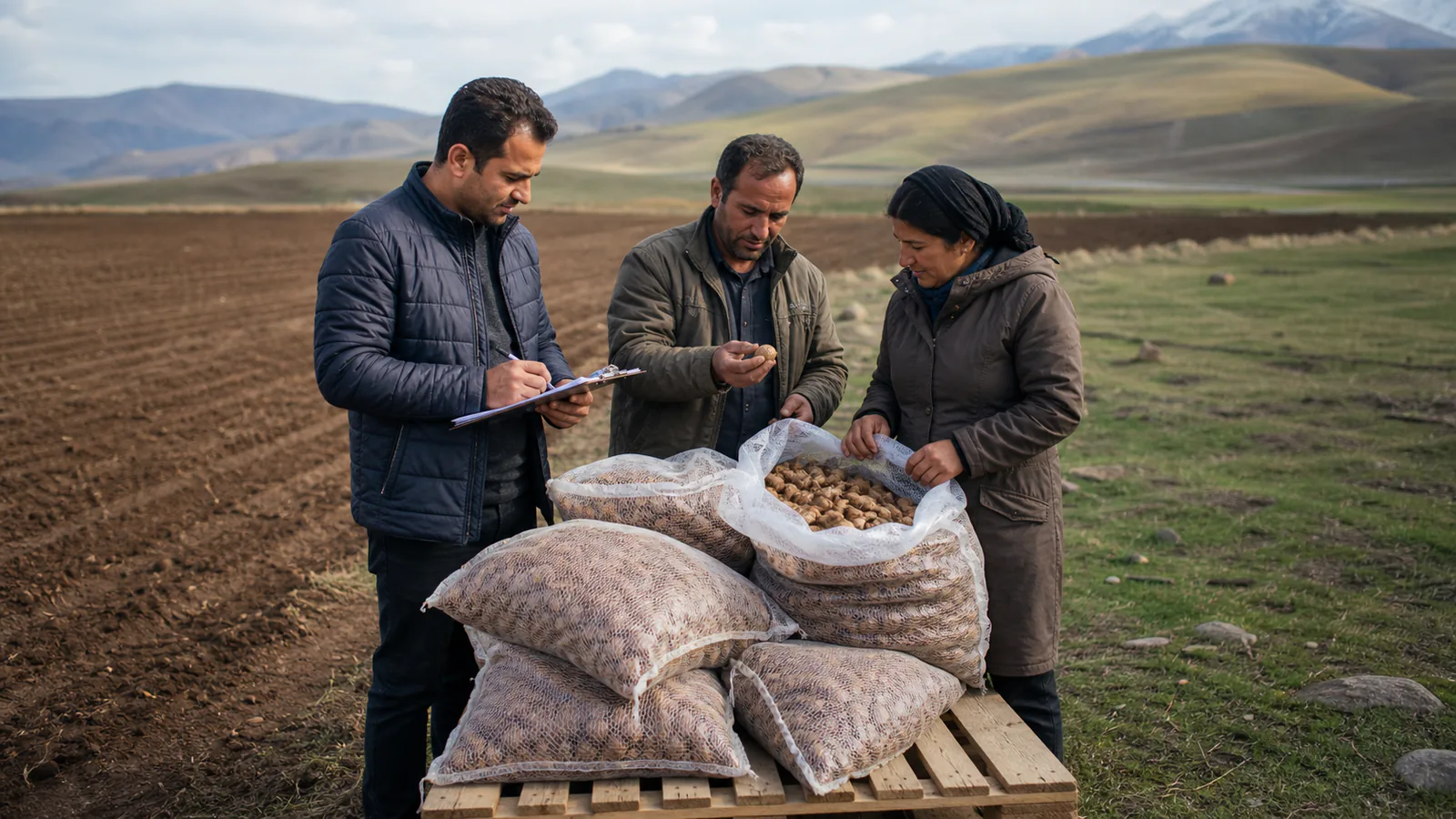
Ardabil’s early saffron-expansion programme distributed about 72 tonnes of saffron corms and reported planting across roughly 50 hectares in eight cities. The announcement came from Adeel Sarvi, then head of the province’s Jihad-e-Agriculture Organization. It presented saffron as a new addition to Ardabil’s crop mix, with a reported yield near 1.5 kilograms per hectare and promising quality-test results.
Those figures describe a historical introduction programme, not the province’s current acreage or production. The surviving articles use relative phrases such as “this year” and “last year,” and the destination page’s dates are internally inconsistent. A careful account can preserve the programme’s scale while separating official claims, simple arithmetic and results that still need independent records.
What the 72-tonne distribution represented
The material distributed to growers was not saffron spice and not botanical seed. It consisted of corms—the underground planting structures often called saffron bulbs or seed bulbs in trade. According to the historical report, the 72-tonne consignment entered Ardabil Province and was distributed among participating farmers in areas considered suitable for cultivation.
A separate report of the same initiative said saffron cultivation and processing had been established locally with support from national and provincial officials and relevant specialists. The Iranian Agriculture News Agency’s contemporary account corroborates the linked figures: about 72 tonnes, eight cities and approximately 50 hectares.
Saffron was reported in eight Ardabil cities
Sarvi described that season as the first time the crop had been cultivated across eight cities in the province through the coordinated programme. The surviving report does not name those eight cities or provide a parcel-level register. It therefore supports the number of participating cities, but not a reliable list of where every field was located.
The distinction matters for a future status check. A programme can distribute material to eight jurisdictions while establishment, survival, flowering and harvest differ from one field to another. Confirming current cultivation would require city names, grower records, planted area by year and subsequent harvest data.
About 50 hectares were associated with the corms
The source connected the 72 tonnes of corms with an area equivalent to about 50 hectares. Dividing the two reported figures gives roughly 1.44 tonnes of corms per hectare. That calculation is useful only as a consistency check. It is not a verified planting rate because both inputs are rounded and distribution does not prove that every corm was planted in the same season.
A defensible programme record would show corm size, lot weight, recipient, parcel, planting density, date and survival. None of those details appears in the archived copies. The 50-hectare figure should therefore remain “about,” not become a precise 50.00-hectare claim.
The reported yield was about 1.5 kilograms per hectare
Sarvi said the Ardabil crop produced about 1.5 kilograms of saffron per hectare. The damaged English copy called the product “saffron chips,” but the context is dried saffron yield. The report does not state whether 1.5 kilograms was an observed provincial average, an initial-trial result or an expected yield.
That uncertainty prevents a total-output calculation. Multiplying 1.5 kilograms by 50 hectares would assume that all land was mature, harvested in the same season and represented by the same yield. Saffron output changes with corm size and density, field age, soil, weather, irrigation and post-harvest handling. The historical figure is best retained as an attributed per-hectare statement.
What the quality ranking does—and does not—show
The source said tests placed Ardabil saffron in first and second positions for quality. It did not identify the laboratory, sample count, test year, comparison group, grade or measured criteria. Without those details, “first and second” cannot responsibly be presented as a continuing national rank.
Saffron quality is normally assessed from defined samples using specified methods, not from the province name alone. The report is still meaningful as evidence that early samples were viewed positively by the programme’s officials. It is not enough to guarantee the grade of every Ardabil harvest or current commercial lot.
Saffron joined a 31-crop provincial mix
Sarvi said 31 types of agricultural products were then cultivated in Ardabil and that saffron had been added as a valuable, established crop in the province’s statistics. This places the programme within crop diversification rather than suggesting saffron replaced Ardabil’s established agricultural base.
The statement did not provide the crop list, land share or value contributed by saffron. “Established” should therefore be read as administrative inclusion in that historical report, not proof that all eight local programmes continued at the same scale.
The water-saving claim needs local measurements
The official described saffron as the least water-demanding and most economical option for managing water under drought conditions. That was a policy and crop-promotion claim, not a measured comparison of all 31 crops in Ardabil. The archived article gives no irrigation volumes, rainfall, yield response or competing-crop data.
Research does support treating irrigation as a managed variable rather than assuming saffron needs no water. A two-year water-balance study at Shiraz University measured seasonal saffron evapotranspiration and crop coefficients, demonstrating that requirements change with growth stage and season. Ardabil’s cooler climate, soil and rainfall require their own field data. “Lower water demand” is a hypothesis to measure locally, not a universal irrigation schedule.
Employment and economics were objectives, not measured outcomes
The source called saffron highly economical in employment, water management and overall returns. Saffron does create labour needs at concentrated points, especially flower picking and stigma separation, but the report supplied no worker-days, wage bill, input cost, sale price or net-margin comparison for Ardabil.
A proper economic assessment would include corm purchase and replacement, land preparation, irrigation, weeding, harvest labour, drying, testing, packaging, losses and the grade-specific selling price. A high product value does not automatically make every field profitable. The programme’s economic language is preserved as its rationale, not converted into a guarantee.
The wider Ardabil agriculture context
In a Planning and Development Council presentation, Sarvi placed the corm distribution within a much larger agricultural programme. The destination article reported 778,000 hectares of agricultural land, agriculture at 28% of provincial GDP and roughly one-third of employment. It also referred to cultivation-pattern working groups involving Mohaghegh Ardabili University and Islamic Azad University.
Those are historical presentation figures with no base year, definitions or statistical table in the surviving copy. One translated production figure—309 million tonnes—is incompatible with a contemporary report describing provincial capacity around four million tonnes, so the corrupted number is not repeated as fact. The land, GDP and employment figures likewise should not be treated as current without an official dated dataset.
Irrigation investment was a separate programme
The destination also mentioned a National Development Fund-backed irrigation network planned across 62,000 hectares, with work on a 12,500-hectare section over a four-year horizon. Contemporary reporting places that scheme in the Khoda Afarin dam command area and describes it as a province-wide agricultural project, not irrigation built specifically for the 50-hectare saffron introduction.
Keeping the projects separate avoids a false causal story. The saffron programme was promoted partly through a water-management argument; the large irrigation scheme was broader infrastructure. The archived article also listed 32 production projects, 23 development projects and construction-credit growth relative to 2012, but it supplied no project register or saffron-specific allocation.
What growers would need before expanding the programme
A future Ardabil cultivation decision should begin with local evidence:
- parcel-level soil, drainage, temperature and rainfall records;
- healthy corm lots identified by origin, size and inspection status;
- planting density and field-age records;
- measured irrigation and rainfall by growth stage;
- flower, dried-stigma and replacement-corm yields;
- laboratory results tied to identified harvest lots;
- labour, processing, packaging and market-cost records.
Without that chain, a strong first sample or official acreage announcement cannot predict the next season. Our review of the Tuyserkan and Shahreza cultivation projects shows the same need to distinguish planted area and forecasts from measured harvest outcomes.
What remains to be verified
The historical account would be stronger with the programme year, names of all eight cities, recipient and parcel registers, exact planted area, corm grades, survival rates and annual yields. The quality statement needs the laboratory, method, sample identifiers and comparison set. The employment and water claims need measured alternatives.
Current acreage is also missing. Neither archived post demonstrates whether the original 50 hectares expanded, contracted or remained productive. This article therefore does not replace a current Ardabil agricultural census or offer planting advice for an unidentified field.
The clearest reading of Ardabil’s 72-tonne programme
The strongest supported account is straightforward: Ardabil officials reported distributing about 72 tonnes of saffron corms, introducing the crop across eight cities and associating the programme with roughly 50 hectares. They cited about 1.5 kilograms per hectare, encouraging early quality tests and possible advantages for water management and employment.
The programme was more than a corm-delivery headline, but it was not proof of permanent success. Preserving its useful facts means keeping the numbers, their official source and their limitations together. That gives growers and readers a coherent historical baseline while making clear which evidence is still needed to judge Ardabil saffron cultivation today.

![Exporting Saffron to Turkey + Price Guide [Complete 0 to 100]](https://img.rowhanisaffron.com/20260827003933/saffron-export-turkey-quality-inspection.webp)



