


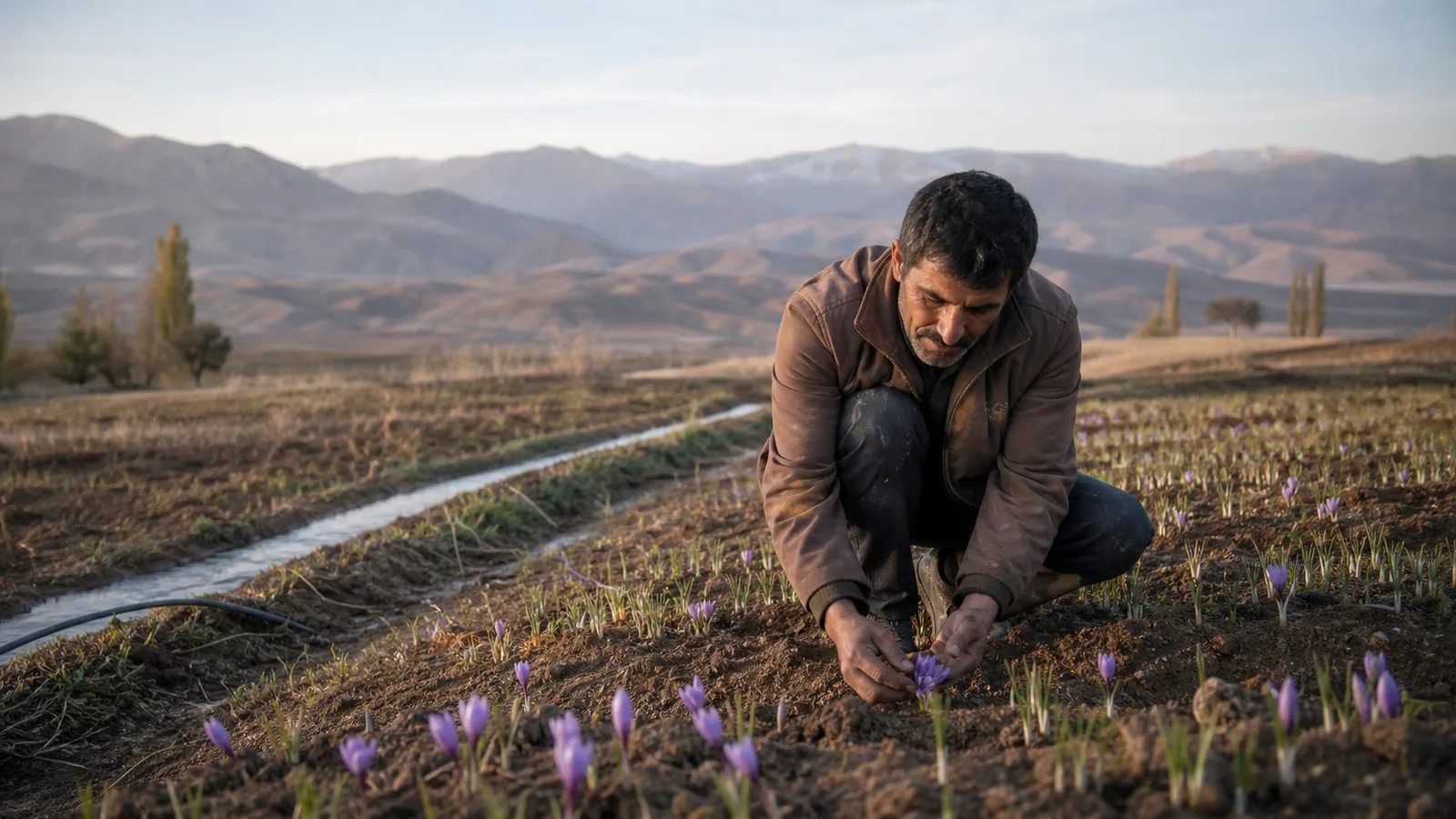
Nazarabad saffron cultivation accounted for more than 70% of the area reported for Alborz province in one local agricultural update. A separate report from Malayer in Hamedan province described a similar expansion, along with higher reported yield and credit tied to grower training.
Both reports are useful historical snapshots, but neither includes a publication-year data table or current programme terms. Their hectare figures, loan amounts and future targets should therefore be read as attributed figures from the original announcements, not as today’s acreage or an open offer from a bank.
Nazarabad’s share of saffron cultivation in Alborz
Iraj Almasi, identified as the director of Agricultural Jihad in Nazarabad, said 42 hectares of land in Alborz province had been allocated to saffron during the reporting year. More than 30 hectares were in Nazarabad. On those figures, the city held at least 71% of the provincial area, which explains the original headline’s rounded “70%” description.
Almasi hoped Nazarabad’s area would double in the following year. That was a target, not a recorded outcome. The source provides no later survey confirming that the city reached roughly 60 hectares, so the projection should not be added to the historical area as if it happened.
The scale was still modest compared with Iran’s established saffron regions. For context, our separately documented account of Khorasan Razavi saffron cultivation concerned tens of thousands of hectares. Nazarabad’s importance in this report came from its share within Alborz and the direction of change, not from national volume.
Why water scarcity encouraged interest
The Nazarabad announcement connected the change to limited water resources. Saffron flowers in autumn and spends much of the year below ground as a corm, so its water calendar differs from many summer crops. That can make it attractive in dry regions, but “low water use” should not be read as “no irrigation needed.”
Timing, soil, rainfall, corm size, field age and irrigation amount all affect the result. A peer-reviewed study of irrigation and corm-planting intensity in a semi-arid region found that cultivation decisions need to be evaluated together rather than reduced to a universal water claim.
For a farmer, the real comparison is not saffron versus an abstract “water-intensive crop.” It is saffron versus the current crop on that field, under the same water allocation, soil constraints, labour market and expected selling channel.
A perennial field still needs annual work
The source says saffron can be harvested “once for up to seven years.” The clearer meaning is that a planted corm field may produce an annual flower harvest for several seasons before renovation or lifting becomes necessary. Saffron is sterile and propagated through daughter corms, not commercial seed; a peer-reviewed botanical review explains that vegetative cycle.
A multi-year stand reduces the need to replant every season, but it does not eliminate field management. Growers still need suitable corms, land preparation, irrigation at the right times, weed and disease management, rapid flower collection, stigma separation and careful drying. Labour demand can be concentrated into a short harvest window.
Claims of high profitability should therefore be tested against the full cycle. Revenue depends on usable dried yield and grade, while costs include establishment, seasonal work, losses, processing, packaging and the route to market.
What the Nazarabad quality claim does and does not prove
Almasi said Nazarabad saffron had a distinctive aroma and that tests by the standards organisation showed high quality. The archived post does not provide a laboratory report, sample count, test date, standard number or measured values. The statement can be preserved as the official’s account, but it cannot support a universal claim about every batch grown in the city.
Meaningful quality documentation would identify the lot and test method and report the relevant results. Origin is context; it is not a substitute for testing. A buyer needs to know what was sampled, when it was analysed and whether storage or handling changed the product after the test.
The reported Nazarabad credit support
The Nazarabad report said more than 300 million tomans in bank facilities had been paid to applicants from rural-development credits to expand saffron cultivation. It did not state the number of borrowers, interest rate, repayment period, amount per hectare, issuing bank or whether the programme continued.
That makes the figure evidence of a historical local support effort, not a current application notice. Prospective growers should obtain written terms from the responsible agricultural office and lender before including credit in a business plan.
Similar expansion in Malayer, Hamedan
Ali Marwat Amiri, identified as Malayer’s Agricultural Jihad director, described farmers moving toward lower-water crops during drought. He said saffron occupied five hectares in Iranian calendar year 1392, corresponding broadly to 2013–14, and 36 hectares in 1395, or 2016–17. The report then placed the area at 85 hectares and set a goal of more than 100 hectares within four years.
These figures show rapid expansion from a small base. They also fit the wider regional pattern described in our review of Hamedan saffron cultivation. They should not, however, be treated as a current Malayer land register without a newer official series using the same boundaries and definition.
The “85% increase” does not match the stated areas
The Malayer source headline reports an 85% increase. Its own area figures do not reproduce that percentage. Growth from 36 to 85 hectares is about 136%, while growth from five to 85 hectares is 1,600%. An 85% increase would require a different baseline that the translated post does not provide.
The responsible approach is to preserve both pieces of evidence and disclose the conflict. The area sequence can be reported as attributed figures. The 85% should remain a headline claim only, not be recalculated into a false certainty or silently applied to the wrong interval.
Malayer’s reported yield improvement
Marwat Amiri said dried saffron yield rose from 2.5 kilograms per hectare to about four kilograms per hectare. That change is 60%, so the percentage in the source is arithmetically consistent.
It is still an attributed local comparison. The report does not state sample size, field age, weather, corm density, harvest method or whether the two values are annual averages. Those details matter because an area-wide average, a demonstration plot and a strong individual farm are not interchangeable.
The useful message is that expansion and productivity should be tracked separately. More hectares can increase total production even when yield is flat; better agronomy can raise yield without adding land. A sound programme records both on a consistent basis.
Training-linked finance in Malayer
The Malayer announcement described low-cost bank facilities of 200 million rials per hectare. Applicants were required to attend classes and receive certification. At the historical conversion of ten rials to one toman, that nominal amount equals 20 million tomans per hectare, but inflation and programme changes make a present-day comparison misleading.
The training condition is more informative than the old nominal amount. Credit can fund corms and establishment, while instruction can reduce avoidable mistakes in site choice, planting, irrigation, harvest and drying. Neither guarantees profitability. Loan terms, eligibility, approved costs and repayment obligations need current written confirmation.
What the two regional reports show together
Nazarabad and Malayer were not presented as replacements for Khorasan. They were examples of regions testing saffron as part of a response to water pressure and rural economic needs. Taken together, the reports point to four questions that any expansion programme should answer:
- Is the hectare figure planted area, bearing area or a target?
- Is yield measured from comparable fields and reported as dry saffron?
- Are quality claims supported by named batch tests and standards?
- Are finance terms current, written and realistic for the full production cycle?
They also show why a percentage alone can mislead. Nazarabad’s 70% sounds large because it describes a share of a 42-hectare provincial total. Malayer’s growth sounds dramatic because it began at five hectares. Both facts can be meaningful without implying national dominance.
A practical reading of the historical data
The strongest conclusion is modest. Local officials reported expanding saffron cultivation, linked it to water constraints and supported growers through credit or training. In Malayer, the official also reported a yield gain. The reports do not prove that every planned hectare was planted, every farm was profitable or every batch met the same quality level.
For readers assessing Nazarabad saffron cultivation today, the next step is newer evidence: a dated agricultural census or local register, bearing-area figures, measured dry yield, laboratory documentation and current finance terms. Until those are available, the historical figures remain useful as a baseline and a record of local policy, not a live forecast.

![Exporting Saffron to Turkey + Price Guide [Complete 0 to 100]](https://img.rowhanisaffron.com/20260827003933/saffron-export-turkey-quality-inspection.webp)



