


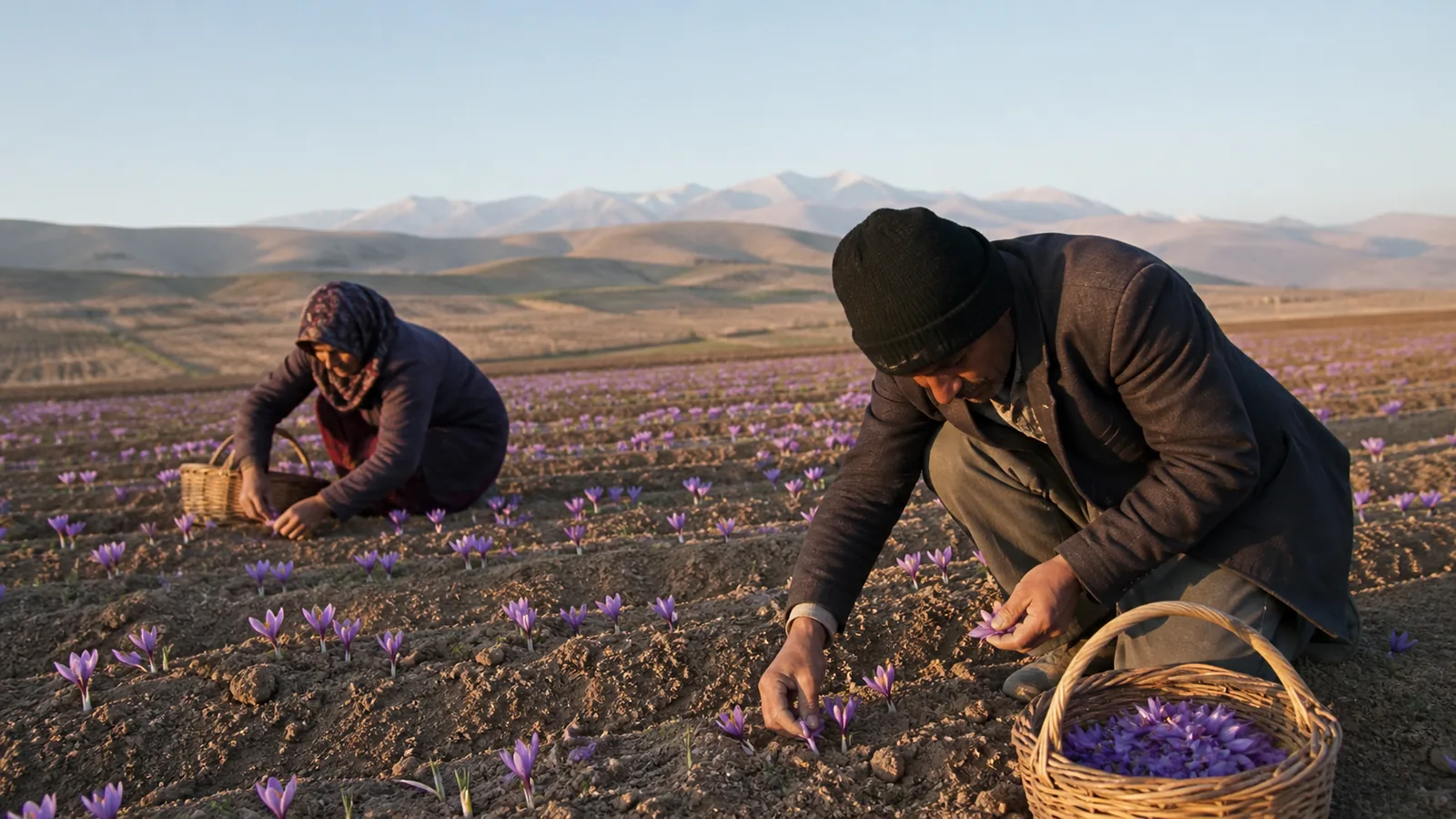
Saffron harvest from the red gold capital of northwestern Iran began with a field ceremony on farms around Bonab in Marand County. The event brought together local agricultural officials, the Bonab mayor and council members, but the more useful story lies beyond the ceremony: later figures described 110 hectares of saffron, a 330-kilogram forecast, farmer cooperatives, packaging capacity and the practical barriers growers still faced.
Historical reports from Natanz and Mehriz provide a wider comparison. They show how different districts used saffron in response to water constraints, but they also contain forecasts and promotional claims that require careful labeling rather than repetition as proven outcomes.
Why Marand was called a northwestern saffron capital
At the Bonab harvest launch, Marand officials described saffron as a crop suited to the district’s autumn and winter growing cycle. They emphasized that much of its seasonal water demand could be met by rain and snow and that it did not require summer irrigation in the same way as many warm-season crops.
That is a local cultivation argument, not a promise that saffron needs no irrigation or succeeds automatically during drought. Field performance depends on rainfall timing, soil drainage, corm quality, planting density, frost, nutrition and flower-harvest labor. A crop can use water in a different season without solving the wider water shortage by itself.
The title “red gold capital of northwestern Iran” is also a promotional description from the original report, not an official national designation or quality grade. It is retained because it identifies how the Marand programme presented itself and because the established page already earns search impressions for this topic.
Marand saffron facts and figures
Rahimzadeh, identified as Marand’s Agricultural Jihad director in the follow-up report, said the city had 110 hectares under saffron. The forecast was about 330 kilograms, while the reported average range was three to four kilograms per hectare.
The district total implies exactly three kilograms per hectare, so it sits at the lower end of that range. Both values were pre-harvest statements; the article did not provide a final dried-weight total or separate young fields from mature ones.
Saffron cultivation in Marand was said to have begun in 2002 and expanded gradually. The report attributed approximately two annual employment opportunities to each hectare. Applied to 110 hectares, that suggests about 220 opportunities, but the source does not define hours, duration or whether these were distinct workers. They should not be presented as 220 permanent full-time jobs.
Cooperatives, packaging and market access
Marand reportedly had three saffron cooperatives representing about 200 farmers. Their main difficulties were described as limited access to bank facilities and technical resources. Agricultural insurance coverage was still being pursued, with officials hoping for a near-term decision rather than reporting that coverage was already in place.
Two saffron packaging units operated in the city. According to the local director, Marand saffron supplied the region and was also sent to other Iranian provinces, Turkey and Azerbaijan. No customs value, shipment quantity, buyer list or period was included, so the export destinations remain attributed market statements rather than independently verified trade totals.
The local value chain matters. Packaging can help a district sell a named, traceable product instead of loose bulk material, but packaging alone does not establish grade or origin. Lot identity, test results, labeling and consistent handling are needed if a regional name is to support a dependable buyer claim.
Harvest forecast in Natanz
Natanz Agricultural Jihad director Abdolreza Mehdi Badi forecast about 1,600 kilograms of dried saffron from 240 hectares. That equals roughly 6.67 kilograms per hectare. The report placed the harvest between the end of October and the end of November.
It also estimated seasonal employment for about 400 residents and said support facilities had been granted to growers. As with the Marand employment figure, the source does not define whether this means people, positions or work engagements, nor does it specify the size or terms of the facilities.
Natanz’s account noted that cultivation was established in mountain areas and had also attracted interest in the desert district of Badrud. Officials connected that uptake to saffron’s relatively limited water requirement. The comparison should remain local: Badrud’s desert setting and Marand’s northwestern climate require different planting and water decisions.
Mehriz expanded from 40 to 48 hectares
In Mehriz, Yazd Province, director Mohammad Jafari said saffron area had increased from 40 to 48 hectares as more farmers participated. That is a 20% increase in planted area. About 300 families were reportedly involved across planting, field care and harvest, and most of the product was sold in Mehriz and elsewhere in Yazd.
The report also said the harvest was expected to rise by 10% in favorable weather. It then forecast “about three kilograms” of high-quality saffron from the region. Read literally against 48 hectares, that would equal only 0.0625 kilograms per hectare, far below the other figures in these reports. The source may have omitted “per hectare” or another unit, but there is no evidence to repair it confidently.
For that reason, three kilograms is preserved as an unresolved reported figure, not used as a reliable district total or yield. The description “high-quality” is also not converted into a verified grade because no sample, laboratory, method or standard was named.
Why the Mehriz health list was removed
The source ended with a generic list saying saffron increases immunity and circulation, protects the heart, controls diabetes, prevents cancer, treats inflammation and provides other medical effects. Those claims were not connected to the Mehriz harvest, cited to clinical evidence or written with appropriate medical limits. They do not help a reader understand this farming report and are not repeated here.
Comparing the three districts without overstating the data
- Marand: 110 hectares and about 330 kg forecast, implying three kg/ha.
- Natanz: 240 hectares and about 1,600 kg forecast, implying about 6.67 kg/ha.
- Mehriz: 48 hectares, but the reported three-kilogram figure has unresolved unit ambiguity.
The implied yields should not be treated as a ranking. Reporting dates, field age, weather and whether the area included immature plots may differ. Marand supplied a yield range, Natanz supplied a district forecast, and Mehriz supplied a figure that cannot be reconciled with its area.
What would confirm the economic story
A complete follow-up should record productive versus new hectares, final dried weight, flower-to-stigma conversion, labor days, corm and water costs, insurance coverage, cooperative sales, packaging volume, laboratory grade, shipment documentation and the net price growers received.
Those measurements would test the claims behind “red gold”: not only whether saffron grew, but whether the crop produced stable income, supported seasonal work and reached buyers in a form that preserved its origin and quality.
Marand remains the center of this account
The Bonab ceremony introduced Marand’s harvest, and the follow-up statistics explain why the district promoted itself as northwestern Iran’s saffron capital. Its 110 hectares, long cultivation history, cooperatives and two packaging units provide a more complete picture than the launch announcement alone.
Natanz and Mehriz add useful context without changing the destination’s purpose. Natanz shows a larger historical forecast and a defined harvest month; Mehriz shows broader family participation and the danger of relying on an unclear unit. Together, the reports support a practical conclusion: expansion is meaningful only when final yield, quality, labor and market evidence are recorded alongside planted area.

![Exporting Saffron to Turkey + Price Guide [Complete 0 to 100]](https://img.rowhanisaffron.com/20260827003933/saffron-export-turkey-quality-inspection.webp)



