


Seven cities of Tehran province were reported under saffron cultivation: Pakdasht, Robat Karim, Varamin, Shahriyar, Islamshahr, Damavand and Shahr-e-Rey. The crop attracted interest because its growth cycle fits the province’s cooler, wetter months and its irrigation demand can be lower than that of many competing crops.
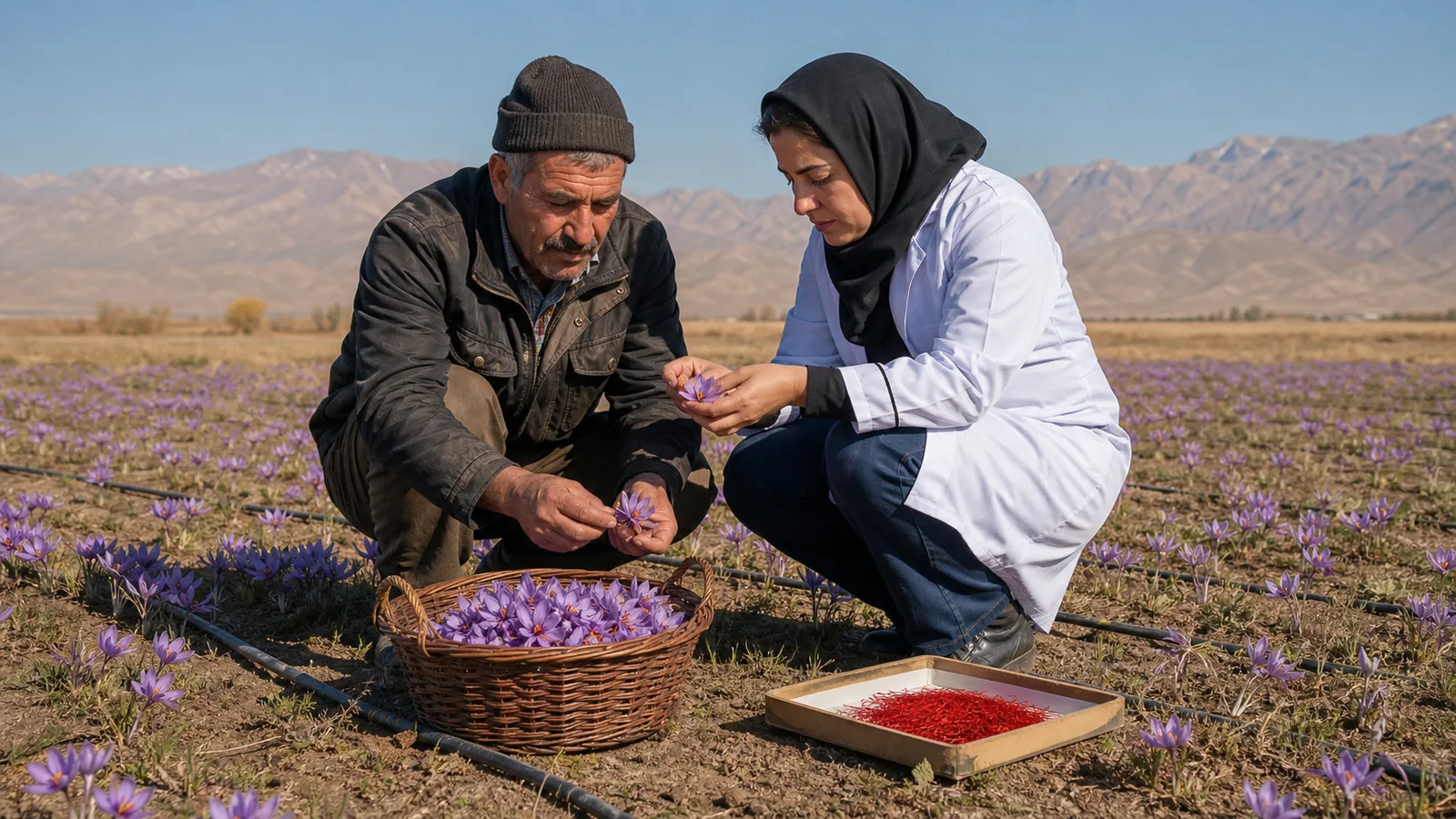
The figures in the original reports are historical, not a 2026 crop estimate. They show how cultivation spread beyond Iran’s traditional Khorasan heartland and why local growers then began asking for better processing, packaging and technical support.
The seven saffron-growing counties
The province-wide account named these counties:
- Pakdasht
- Robat Karim
- Varamin
- Shahriyar
- Islamshahr
- Damavand
- Shahr-e-Rey
Its initial snapshot described 150.1 productive hectares, output of 0.81 tonnes and an average yield of 5.4 kilograms per hectare. A later Tehran Agricultural Jihad report from 2019 put the cultivated area above 170 hectares and specified 174 productive hectares, 0.95 tonnes and 5.5 kilograms per hectare. It retained the same seven counties.
That report ranked Tehran seventh nationally by production and second by yield per hectare for its reporting year. Rankings and yields change with weather, field age and the area counted as productive, so they should not be repeated as current without a same-season official dataset.
Why saffron can fit Tehran’s rainfall cycle
Saffron begins active growth as autumn temperatures fall and seasonal rain returns. Flowers appear in autumn; leaves continue through the cooler months and support the corm before the plant enters summer dormancy. The earlier article described a roughly five-month dormant period beginning around mid-May.
That cycle reduces the need to maintain a leafy crop through Tehran’s hottest months. It does not make saffron water-free. The 2019 provincial report described three irrigation points: one before harvest around mid-Mehr, one after harvest around mid-Azar, and another near the end of Esfand. Actual timing must respond to soil, rainfall, temperature, field age and local agricultural advice.
Temperature and moisture affect flowering, but the original claim that lower temperature alone increases yield is too simple. Excess heat, frost at a sensitive stage, poor drainage, untimely irrigation, corm health and farm management can all alter the result. A field trial is safer than assuming that every part of a county will perform like its best site.
Varamin and the role of Javadabad
Varamin’s earlier production was concentrated in Javadabad, an important agricultural district in the county. Mohammad Hossein Tajik, then head of the local Agricultural Jihad office, reported more than five hectares under saffron, with an average harvest of about 4–5 kilograms per hectare.
An official 2017 provincial account gives an annual Varamin harvest of approximately 20–25 kilograms. Harvest began during Aban and could continue into early Azar, broadly from late October into late November depending on the Persian calendar year and field conditions.
Those figures describe the county at that time. The later province-wide total cannot be used to calculate Varamin’s present share because it does not provide a new county breakdown.
The missing processing and packaging link
Varamin growers identified the lack of a local saffron processing and packaging centre as their main commercial problem. Without a suitable facility, small lots were more likely to leave the county before drying, grading, testing and consumer packing created additional value. The product could reach the market, but not necessarily under a recognisable Varamin identity.
A local centre would only help if it solved practical problems:
- rapid receipt and hygienic handling during the short flower harvest;
- controlled stigma separation and drying;
- separate, traceable lots rather than anonymous mixing;
- moisture, sensory and authenticity checks;
- food-grade packs with accurate weights and labels;
- documented payments and grades that growers can understand.
Packaging by itself does not prove quality. It preserves and communicates quality only when the underlying lot and process are controlled.
What “additive-free Varamin saffron” means
A local grower, Mohammadi, described Varamin saffron as additive-free and among the best sold in the domestic market. That is a producer’s attributed assessment, not a comparative laboratory study. Pure saffron should be free of added colour, plant material or other substances regardless of where it grows.
The international Codex saffron standard CXS 351-2022 permits no food additives in the products it covers and sets physical and chemical criteria for graded dried saffron. Origin can influence a lot’s character, but an origin claim is not a substitute for testing.
How scientific cultivation can improve the result
Economist Hossein Hosseini called for incentive packages and more science-led farming. In practice, support is most useful when tied to measured field needs rather than blanket expansion. Growers need healthy corms, suitable planting density and depth, well-drained soil, a realistic irrigation plan, nutrition based on soil conditions and enough trained labour for the harvest.
Our saffron planting guide explains the crop cycle. For a commercial field, local soil and water tests, pest monitoring and records by plot are essential. Yield per hectare should be calculated from dried saleable saffron, not flower weight or wet stigmas.
Expansion also needs a market plan. Five additional hectares do not automatically produce better farm income if every grower harvests at once, drying capacity is inadequate or buyers cannot distinguish one lot from another. Processing and sales capacity should grow with cultivated area.
A realistic reading of Tehran’s saffron opportunity
Saffron offered Tehran province a high-value crop whose active season could fit local rainfall and avoid peak-summer irrigation. The seven-county record and Varamin’s Javadabad experience show genuine local production, not just a proposal.
The opportunity is still conditional. Water must be managed, sites must be tested, harvest labour must be available, and clean drying and traceable packing must follow the field work. When those pieces are connected, Tehran-grown saffron can be sold for what it demonstrably is—not merely for a regional claim printed on a box.

![Exporting Saffron to Turkey + Price Guide [Complete 0 to 100]](https://img.rowhanisaffron.com/20260827003933/saffron-export-turkey-quality-inspection.webp)



