


The Mahneshan saffron harvest expanded from an early reported 4.2 hectares to 17 hectares in a later local update. That later account recorded 45 kg of dried saffron, income above 270 million tomans and employment for 35 people. Read together, the reports show how a small diversification programme developed, while leaving important limits around dates, costs and water use.
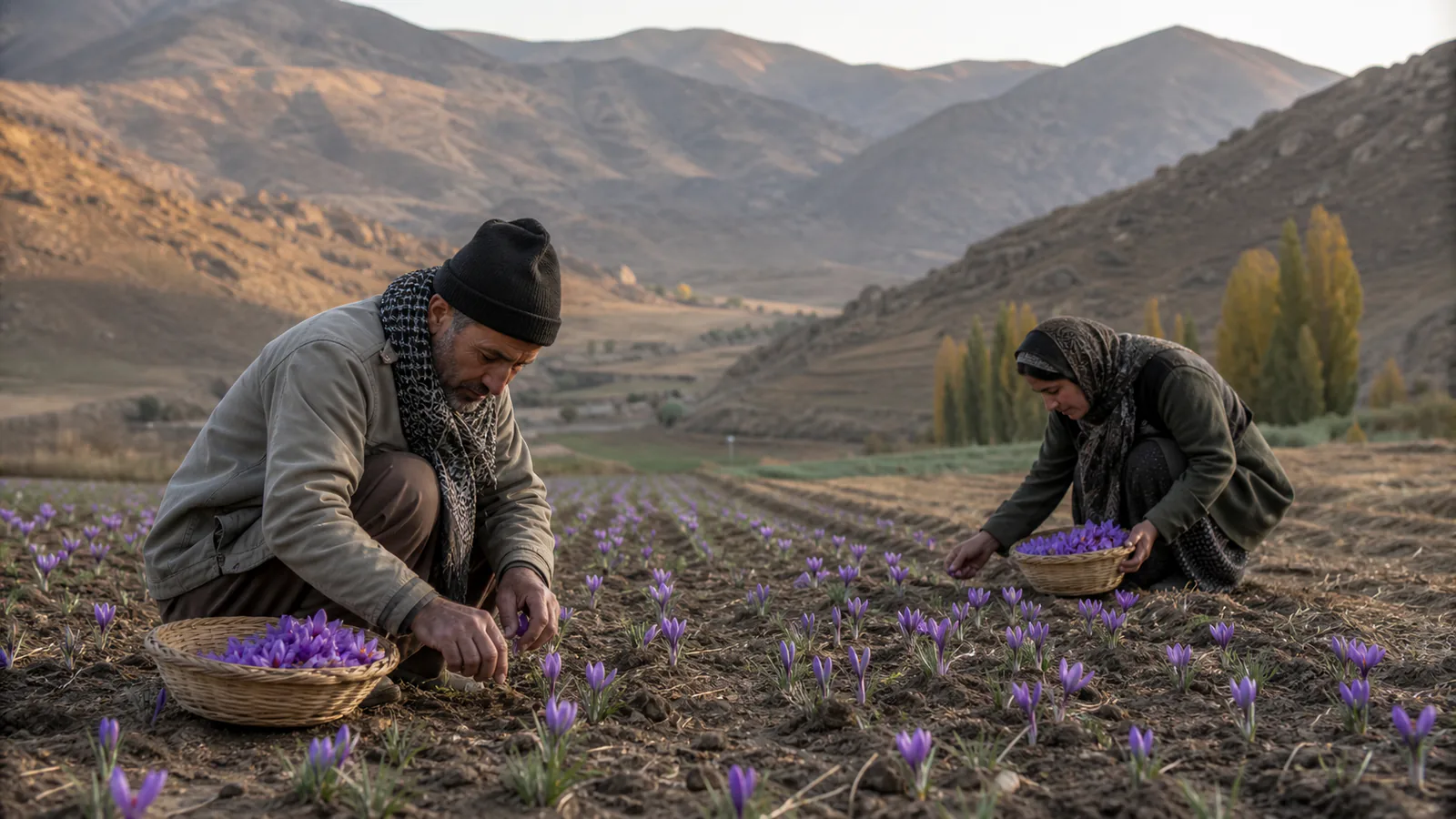
The acreage and output figures are historical. Neither report names its crop year in the stored English text, and neither provides a farm-level dataset. This article therefore treats the 4.2- and 17-hectare accounts as separate snapshots rather than assigning them an invented calendar.
The first reported 4.2 hectares
Akbar Taybi, then identified as director of Mahneshan Agricultural Jihad, described an early saffron programme covering approximately 4.2 hectares. The office promoted saffron to diversify farm products and income while making use of local soil, water and climate.
Support included classes and workshops, help obtaining planting material, and advice through planting, field care and harvest. The old translation calls the planting material “standard seeds,” but cultivated saffron is sterile and is propagated with corms. No supplier, corm grade, quantity or certification standard is named.
Taybi said the first crop had been sent to domestic markets in the previous year. The report does not identify buyers, destination provinces, quantity, grade or price. It establishes an initial domestic sales channel, not a continuing contract.
Expansion to 17 hectares and 45 kg
In the later update, Reza Ajamloo of Mahneshan’s agriculture office reported 17 hectares and 45 kg of dried saffron. The English text awkwardly calls this “the area of saffron harvest (dry stigma),” but hectares measure land; 45 kg is the dried product.
If all 17 hectares were bearing and supplied the stated 45 kg, the implied average is approximately 2.65 kg/ha. The source does not distinguish young from mature fields, so that calculation is only a scale indicator.
Compared with 4.2 hectares, 17 hectares is just over four times as much land—an increase of 12.8 hectares. The reports do not provide reliable dates or a shared measurement method, so this should be read as evidence of expansion, not a precise annual growth rate.
Understanding the 270-million-toman income figure
Ajamloo said the crop generated more than 270 million tomans. If that amount refers to the same 45 kg, it implies gross revenue above 6 million tomans per kilogram. The source does not explicitly confirm the denominator, however, and the amount is historical.
Revenue is not profit. The report gives no corm, labour, irrigation, fertiliser, land, drying, packing or transport costs. It also provides no grade mix, sales date or price per transaction. The 270-million-toman figure should not be used as a current saffron price or as a promise of earnings from 17 hectares.
Inflation and market changes further limit comparisons with a later season. The figure remains valuable as a reported local total, but only within its own unidentified reporting period.
What 35 jobs means—and what it does not
The later account associated Mahneshan’s saffron cultivation with employment for 35 people. It does not say whether these were growers, family workers, seasonal flower pickers, stigma separators, full-time equivalents or unique people across the season.
The number is therefore preserved as a reported headcount, not converted into jobs per hectare. Saffron work is concentrated around a short flowering and processing window, so temporary participation and year-round employment are different measures.
Saffron as an alternative crop
Ajamloo presented alternative cropping as a way to increase productivity while reducing water use, with saffron among the options. Taybi likewise encouraged farmers to consider local suitability and obtain guidance from agricultural centres.
Neither report supplies irrigation volumes, rainfall, soil-water data or a comparison crop. The supported conclusion is that local officials promoted saffron within a water-conscious diversification policy. It is not possible to calculate litres saved per hectare or claim that every Mahneshan field used less water.
Crop suitability also depends on more than a county-level climate label. Drainage, corm health, field history, irrigation timing, winter conditions, labour availability and drying practice can determine whether a particular site succeeds.
Planting time cannot be reduced to one June date
The early article closes by saying the best planting time depends on climate, then places it in “spring (June).” That phrasing is internally awkward: June spans late spring and early summer, and local saffron planting calendars vary.
The report does not give soil temperature, altitude, irrigation plan or a local trial supporting one fixed date. The final article therefore preserves the useful principle—timing is climate-dependent—without turning June into universal advice.
Support requested by producers
Ajamloo said residents had welcomed the crop and that producers needed serious government support. The source does not define whether that meant finance, corm supply, irrigation, insurance, training, processing, testing, packaging or market access.
A useful future assessment would need the requested programme, eligibility rules, funding, recipients and outcomes. For this historical account, the safe conclusion is narrower: local officials saw continued interest but believed expansion required more public support.
Unsupported health claims removed
The early post said saffron reduces fat, cholesterol and blood pressure and increases vitality. It gave no clinical source, dose, population, preparation or safety context. Those treatment-like claims are not necessary to explain Mahneshan agriculture and are not retained as health advice.
This page stays with what the reports can support: cultivated area, dried output, historical income, employment, training and policy. Product health information would require a separate evidence-led review and appropriately cautious language.
What the Mahneshan reports establish
- An early programme covered approximately 4.2 hectares and included classes, corm support and field guidance.
- A later update reported 17 hectares and 45 kg of dried saffron, implying about 2.65 kg/ha only if all 17 hectares were bearing.
- Reported income exceeded 270 million tomans, but costs and the exact relationship to the 45 kg total were not documented.
- Employment was reported for 35 people without a definition of job duration or role.
- Local officials promoted saffron as an alternative crop under water pressure and called for further producer support.
- All figures are historical and should not be used as current area, output, price or employment data.
The Markazi saffron expansion reports offer a larger comparison with similar training and market themes. The Natanz harvest account shows how vocational education and local processing can accompany acreage growth.
Sources and reporting limits
- Two historical Mahneshan reports consolidated here, attributing the early programme to Akbar Taybi and the 17-hectare update to Reza Ajamloo.
- Peer-reviewed research explaining that cultivated saffron is sterile and propagated through corms.
The sources lack crop-year labels, field methods and final programme records. Conditional arithmetic is identified as such, while unsupported medical, profitability and water-saving claims are not converted into facts.

![Exporting Saffron to Turkey + Price Guide [Complete 0 to 100]](https://img.rowhanisaffron.com/20260827003933/saffron-export-turkey-quality-inspection.webp)



