


The cost of saffron is high because each flower yields only three delicate stigmas, the harvest has to be gathered within a short flowering season, and separating and drying the threads takes skilled work. What a buyer pays also reflects grade, origin, testing, packaging, quantity and the route from grower to shop. Understanding that high cost starts with comparing saffron by weight and evidence of quality rather than by the price of a jar.
Why does saffron cost so much?
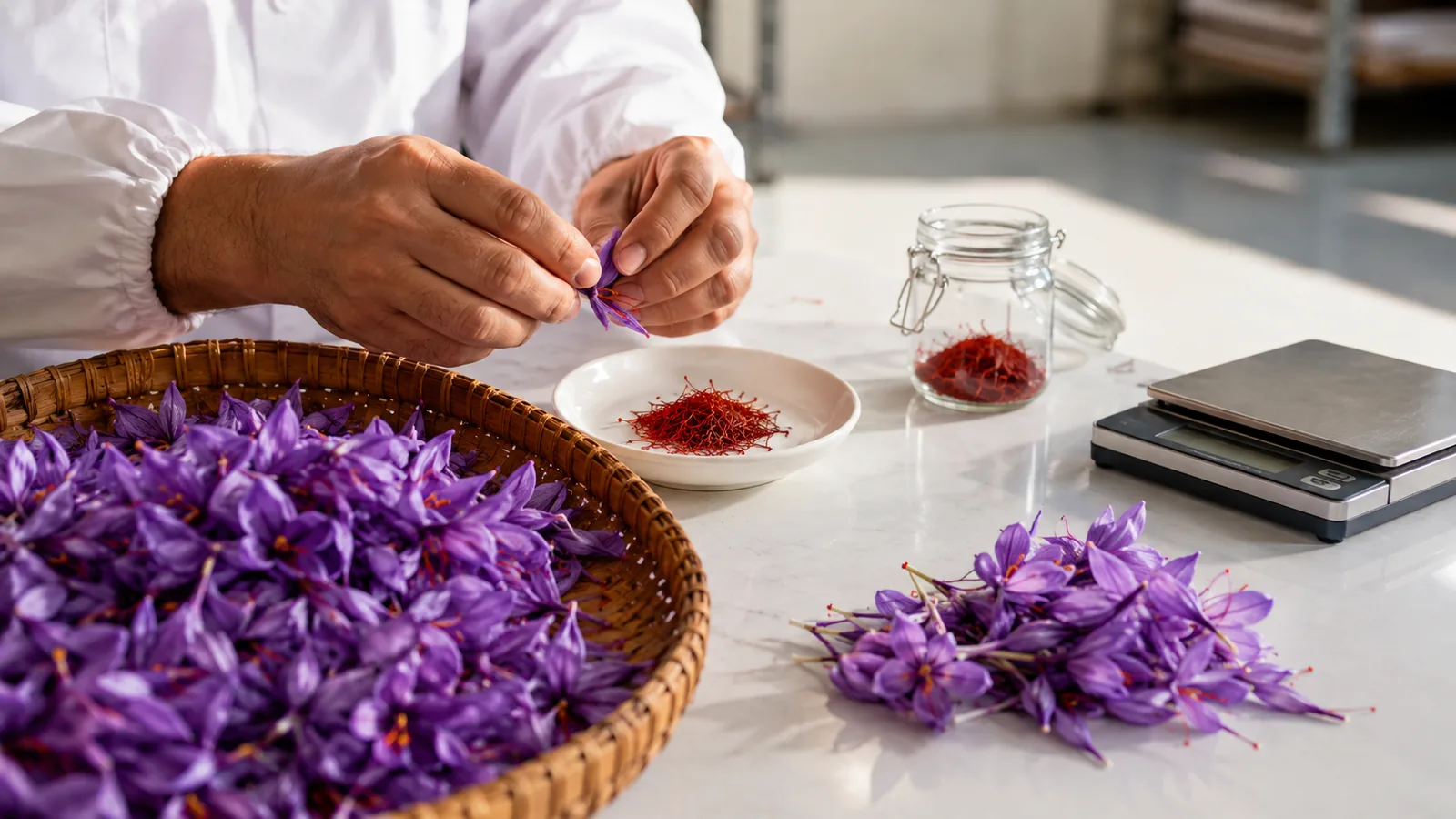
Saffron is the dried stigma of Crocus sativus, not a seed, bark or leaf that can be harvested in bulk. Every flower produces three stigmas. They are light enough that a very large number of flowers is needed for a kilogram of finished spice.
A peer-reviewed study of saffron quality notes that one kilogram of dry saffron requires roughly 110,000–165,000 flowers. It estimates about 50 hours to pick those flowers and another 200 hours to separate the stigmas. Those figures vary with the field, workers and method, but they show why the labour cannot be compared with harvesting an ordinary dried herb.
The work also arrives all at once. Flowers are collected during a brief seasonal window, then handled promptly so that the stigmas can be separated and dried under controlled conditions. A grower needs enough trained labour at precisely the right time; delaying the work can reduce the value of the crop. That labor-intensive schedule is one reason why saffron is expensive even before it leaves the producing region.
Where the price is created
Corms, land and a crop that takes planning
Saffron grows from corms planted in suitable soil. A farm has to buy and sort planting material, prepare the field, manage weeds and irrigation, watch for disease and protect future yields. The saffron farming cost is therefore more than the wages paid during flower picking. Land, water, equipment, storage, crop losses and finance all sit behind the final gram.
Climate and field management affect yield. A harvest from one region or year cannot simply be assumed to match another. The site’s fuller guide to saffron production in Iran and worldwide explains how production, exports and origin should be distinguished.
Picking and separating by hand
Flowers are fragile and close to the ground. The valuable red stigmas must be separated from the rest of each flower without adding too much yellow style or foreign material. Mechanisation may help with some field operations, but harvesting and separation still demand considerable manual handling in much of the trade.
Wages differ between producing countries, yet low farm wages do not make the process free. A price that cannot reasonably cover careful harvest and processing should prompt questions about age, grade, adulteration or how much saffron is actually in the package.
Drying turns fresh stigmas into the spice
Fresh stigmas contain moisture and do not yet have the stable characteristics buyers expect. The drying process reduces their weight dramatically and develops the familiar aroma while preserving colour and flavour compounds. Too much heat can damage the product; too little or uneven drying can leave an unstable lot.
This stage requires time, judgement and equipment. Sorting after drying removes pale style, broken material and contaminants. The finished quantity is a small fraction of the flowers brought in from the field.
Quality makes two saffron prices difficult to compare
A low and a high quote may describe products that are not equivalent. Whole red threads, material with more yellow style, short broken threads and powder can differ in visual grade and risk. Laboratory measurements of colouring strength, aroma-related compounds, bitterness-related compounds, moisture and foreign matter provide more useful evidence than a decorative grade name alone.
The published study of saffron’s commercial quality describes how composition, post-harvest handling and storage influence quality. It also supports keeping dried stigmas sealed away from moisture and light. A certificate is most useful when it identifies the tested lot, laboratory, method and date; a generic certificate attached to a sales page may not describe the jar in front of you.
Origin can affect value, but the label needs context
Origin affects labour, regulation, reputation, transport and how buyers perceive the product. Iranian, Kashmiri, Spanish, Afghan, Greek, Moroccan and other saffrons may reach the market through very different supply chains. The cost of saffron in Iran cannot be carried unchanged into another country’s shop because packing, currency, transport, tax and retail margins intervene. Country name alone does not prove a particular grade or chemical profile.
Why is Spanish saffron so expensive in some shops? Part of the answer may be local production costs, certification, smaller protected-origin supply, European packing costs and retail positioning. It may also be saffron grown elsewhere and packed or distributed through Spain, depending on the label. Read the stated country of origin separately from the address of the packer.
Protected geographical names and documented single-origin lots can command more because they offer traceability and limited supply. That premium is meaningful only when the claim is genuine and the lot still has good sensory and analytical quality.
Testing, packaging and transport add real costs
Responsible traders may pay for sampling, laboratory analysis, food-safe containers, tamper evidence, lot coding, documentation and controlled storage. Small retail packs cost more per gram to fill and label than one bulk container. Glass, presentation boxes and protective shipping material also add weight and handling.
Transport cost matters, but saffron’s high value and low weight mean that paperwork, insurance, distribution margins and compliance can be more important than freight alone. Every intermediary performs a role or adds a margin. Buying closer to a producer may shorten the chain, although it does not remove the need to test the product and verify the supplier.
Does global demand explain the high price?
Demand contributes, but it is not a complete explanation. Saffron is used in cooking, gifting, fragrance traditions and some researched preparations, while harvest volume cannot expand instantly in response. Exchange rates, regional crop conditions, inventories and wholesale buying can move prices from one season to the next. Saffron costs also differ between a farm-gate lot, an export shipment and a finished retail pack.
It is too simple to say that demand always rises or that saffron always becomes more expensive. Market prices can fall when supply is strong, stocks are released or exporters compete aggressively. A current quote should therefore include its date, currency, quantity, grade and delivery terms.
How much does saffron cost?
There is no single lasting answer. Saffron cost changes by country and date, and retail jars, restaurant packs and verified wholesale lots are priced on different terms. For a current quotation, use the site’s saffron price page and confirm what weight, origin, grade, test evidence, packaging, tax and delivery the figure includes.
To compare two offers, convert both to the same unit. Divide the total product price by the net grams of saffron; do not include the jar’s weight. Then adjust for taxes and delivery so both figures are either landed prices or product-only prices. A three-gram pack at a lower total price can still have a higher price per gram than a ten-gram pack.
For wholesale saffron pricing, also compare payment terms, minimum order, sampling method, insurance, rejected-lot policy and whether the stated price changes after laboratory results. “Per kilogram” is not a complete commercial offer without those details.
How expensive is saffron in an actual recipe?
The jar price looks dramatic because saffron is sold in tiny quantities, but a dish normally uses a fraction of a gram. If a recipe uses 0.2 grams, multiply the price per gram by 0.2 to find the spice cost for the whole dish. Divide that result by the number of servings for the cost per person.
Measuring carefully is more useful than adding a large pinch. Grind a small portion, infuse it and distribute the liquid through the dish. Better extraction can give clearer colour and aroma without using more threads. The calculation also makes it easier for a restaurant to price a menu item consistently.
What is saffron worth to a buyer?
Worth depends on whether the saffron is authentic, suitable for the intended use and honestly represented. A lower-priced lot can be good value when it has sound testing, clean aroma, useful colouring strength and simple packaging. An expensive gift box can be poor value if most of the price is presentation or if the product has been stored badly.
For cooks, value often means a small amount of strong, fresh threads that performs predictably. For a trader, it also includes consistency between lots, traceability, documentation and a supplier who deals clearly with nonconforming goods. For a grower, a viable price must cover the work and risk of producing the crop.
Warning signs behind an unusually low price
A cheap offer is not automatically fraudulent, and an expensive one is not automatically pure. Still, a price far below comparable offers deserves a closer look. Check for:
- an unclear net weight or a price based on the package rather than the saffron;
- powder when the offer appeared to show whole threads;
- large amounts of pale style, plant debris or threads of inconsistent shape;
- origin, grade or harvest claims without lot-specific records;
- only a generic laboratory sheet with no link to the supplied batch;
- strong colour released instantly in cold water alongside weak natural aroma;
- pressure to skip sampling before a large order.
Home checks can reveal obvious problems, but they cannot replace appropriate laboratory analysis for a commercial lot. Sampling has to represent the shipment; testing a specially selected jar proves little about the rest.
Is saffron worth its price?
For a cook who values its particular aroma, colour and flavour, a small quantity can serve many dishes. For a business, it is worth the price only when the quality, documentation and consistency support the intended product. Claims about broad “medicinal benefits” should not be used to justify a premium without precise, lawful evidence.
The high saffron spice cost begins with biology and labour, then changes through drying, quality, origin, testing, packaging and trade. Compare like with like, calculate the price per gram, and ask what evidence accompanies the lot. That gives a clearer answer than treating every red thread—or every expensive box—as equal.

![Exporting Saffron to Turkey + Price Guide [Complete 0 to 100]](https://img.rowhanisaffron.com/20260827003933/saffron-export-turkey-quality-inspection.webp)



