


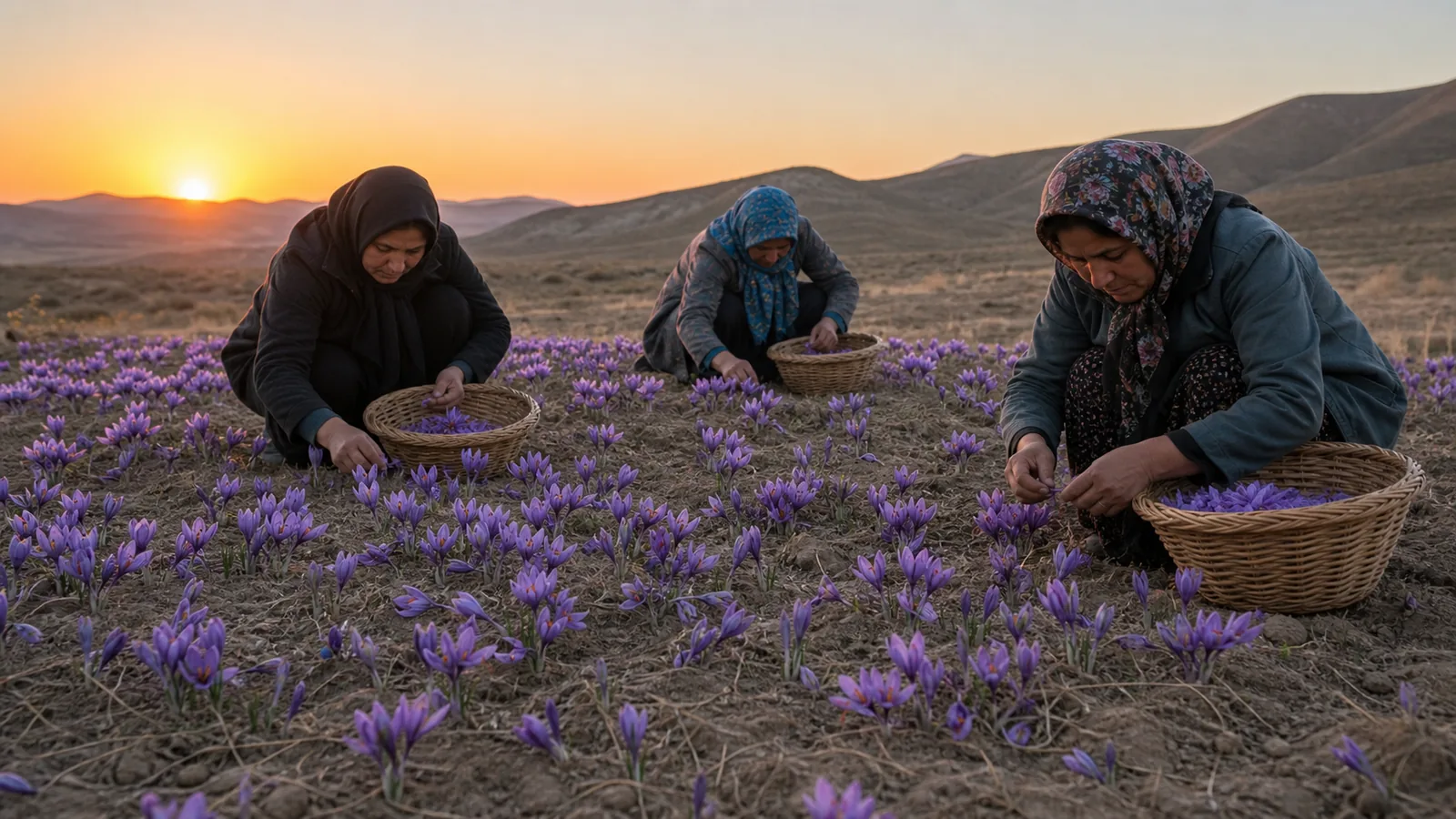
Production of saffron in Iran combines an autumn-flowering crop, generations of field knowledge, and a labour-intensive harvest. Iran remains the world’s leading producer. The Food and Agriculture Organization describes its share as more than 90% of global production, with Khorasan Razavi and the Gonabad area at the heart of a farming system adapted to an arid and semi-arid landscape.
That scale does not make every field the same. Planting date, soil, corm health, irrigation water, temperature, field age, harvest speed, drying, and storage can all change yield and finished quality. It is more useful to understand the production chain than to reduce Iranian saffron to a single percentage.
Why saffron production is concentrated in eastern Iran
Saffron has a life cycle suited to regions with dry summers and cool autumns. The corm stays dormant through the hottest period, flowering begins after conditions change in autumn, leaves continue growing through winter and spring, and the plant returns to dormancy as the leaves yellow.
Khorasan’s long experience matters as much as climate. Growers know how to choose corms, time the first irrigation, loosen the soil surface, collect flowers quickly, separate stigmas, and dry the spice. Local labour networks and trade knowledge have developed around that short harvest window.
Gonabad offers a particularly clear example. FAO recognised its qanat-based saffron farming system as a Globally Important Agricultural Heritage System. The organisation reports more than 2,000 hectares of saffron farmland around Gonabad and explains how underground qanat water supports farming where surface water is scarce.
Planting saffron corms
Saffron is sterile and is propagated vegetatively with corms, not seed. Growers select sound planting material, prepare well-drained ground, and plant while the corms are dormant. The right calendar varies by elevation, temperature, soil, irrigation system, and local practice, so a national article should not prescribe one September date to every farm.
Corm size, planting density, depth, and field age affect the number of flowering shoots and the production of daughter corms. Very dense planting can produce an early return but may reduce long-term efficiency as corms compete for space and resources. A Gonabad farm-efficiency study found that excessive planting density was associated with poorer technical efficiency and land-use sustainability.
Irrigation and flower emergence
Saffron is often called a low-water crop, but that does not mean water timing is unimportant. In much of Iran, irrigation before flowering helps initiate emergence when autumn rainfall is insufficient. A 2024 field study found a major yield penalty when pre-flowering irrigation was omitted under the semi-arid conditions tested. The result supports careful scheduling, not a universal volume for every soil and climate.
After the first irrigation, growers may break a hard surface crust so shoots and flowers can emerge with less obstruction. This is a shallow operation: the aim is to open and level the surface without cutting emerging shoots or damaging corms below. A hoe, light cultivator, or another locally suitable implement may be used according to field layout and soil condition.
Later irrigation supports leaves and daughter-corm development through the active season. Fixed instructions such as watering every six to twelve days until April are too broad for an entire country. Rainfall, soil water-holding capacity, salinity, temperature, field age, rooting depth, and irrigation method should determine the schedule.
From flower to dried saffron
Flowering creates a brief period of intense work. Pickers collect the purple flowers, usually early in the day, before prolonged sun and handling damage them. The red stigmas are separated from the rest of the flower and dried under controlled conditions. The final product is only a small fraction of the fresh floral material.
Speed and cleanliness matter at this stage. Soil, wet containers, compression, delayed separation, excessive drying heat, and poor storage can reduce quality or create contamination risk. Production therefore continues well beyond what happens in the field: lot identification, hygienic handling, moisture control, packaging, and traceability are part of the same chain.
What a “record yield” means
One source article reported an exceptional harvest from Ferdows in South Khorasan. It named farmer Ali Akbarnejad and said a visiting agricultural group recorded 43 kilograms of dried saffron per hectare on a 4.5-hectare farm. The story described a previous record of about 35 kg/ha by Hussein Imam and contrasted both figures with roughly 3.5 kg/ha in drought years. It attributed the result to fertilisation, irrigation, and crop management carried out with expert guidance.
Those figures should be read as a historical local report, not a yield promise. The article did not supply weigh tickets, moisture measurements, field boundaries, age of the stand, sampling method, or an independent publication. A broad scientific review puts reported saffron yields more commonly in a range of about 2–28 kg/ha, depending on conditions. A 43 kg/ha claim is therefore an outlier that needs unusually strong documentation before it is used as a benchmark.
The useful lesson is not the headline number. It is that yield per hectare reflects a connected system: healthy corms, suitable density, water at the right stage, balanced fertility, weed control, careful harvest, and accurate dry-weight measurement.
Should saffron cultivation expand beyond Khorasan?
The older opinion piece questioned official support for saffron in other provinces. Its concern was that simply expanding acreage would not solve agricultural water problems, might weaken average quality, and could put pressure on established Khorasan growers and the reputation of Iranian exports.
That concern deserves a balanced answer. Saffron can use less water than many conventional crops and may offer high value per unit of water; FAO highlights that advantage in water-scarce Gonabad. But changing the crop does not repair an overdrawn aquifer if total irrigated area keeps growing or water savings are used to cultivate more land. Water accounting must cover the whole basin, not only one hectare.
Nor is quality guaranteed by a province name alone. Environment and regional expertise matter, but corm quality, agronomy, harvest handling, drying, testing, and storage determine the lot a buyer receives. Expansion should follow site trials, water budgets, soil and salinity assessment, access to trained labour, and a realistic route to market. Our report on saffron harvesting in Qom Province shows how small non-Khorasan programmes need to be evaluated on their own evidence.
Iran’s share of world saffron production
A 2021 source quoted Mohammad Reza Modoudi of Iran’s Trade Promotion Organization as saying that Iran produced 97% of the world’s saffron but did not control its market or price. The exact share changes with season and dataset. FAO’s more durable formulation—over 90%—is the safer current description unless a dated production series is supplied.
Modoudi’s larger point was about value capture. Producing most of a commodity does not automatically give farmers or exporters control over retail positioning, consumer trust, or the final selling price. He criticised weak brand development and called for stronger Iranian export brands. His speech also cited Iran as 28th by GDP and the world’s 19th-largest market; those dated, broad rankings do not measure saffron competitiveness and should not be reused as current statistics.
Why branding starts before the package
A credible saffron brand cannot be built from a logo alone. It begins with repeatable product specifications and records that connect a packaged lot to its origin and processing history. Buyers need confidence in identity, grade, moisture, cleanliness, net weight, and consistency.
For Iranian producers, that means aligning cultivation and post-harvest work with testing, traceability, honest origin claims, and packaging that protects the threads. Stronger branding can then explain what is genuinely distinctive about a lot instead of relying only on Iran’s production share.
The full picture of saffron in Iran
Iran’s leadership comes from more than acreage. It rests on a crop adapted to dry regions, historic water systems, skilled seasonal labour, and a deep body of local knowledge. The weaknesses identified in the source articles are equally real: water scarcity, uneven farm practice, extraordinary claims without enough documentation, and a gap between production scale and branded value.
The best future for saffron production in Iran is therefore not maximum expansion at any cost. It is efficient water use, healthy multi-year fields, careful harvest and drying, reliable measurement, transparent quality control, and brands that return more value to the people who produce the spice.

![Exporting Saffron to Turkey + Price Guide [Complete 0 to 100]](https://img.rowhanisaffron.com/20260827003933/saffron-export-turkey-quality-inspection.webp)



